TL;DR: Paris has three real ways to buy Catholic jewelry: independent religious jewelers around Place Saint-Sulpice (Georges Thuillier, La Procure, Au Service de la Liturgie), on-site boutiques at Notre-Dame and Sacré-Coeur, and Sanctis, a French house selling solid gold and silver medals online with international shipping. Saint-Sulpice wins on variety and in-person browsing. The cathedral boutiques win when the medal needs to be tied to that specific church. Sanctis wins when there’s no time for boutique-hopping, since everything ships home, engraved, without spending an afternoon crossing Paris.
| Saint-Sulpice Quarter | Cathedral Boutiques (Notre-Dame & Sacré-Coeur) | Sanctis (Online) | |
| Type | Independent religious jewelers, since 1919–1948 | On-site shops run by the cathedral/basilica | French jewelry house, online only, since 1959 |
| What you’ll find | Medals, crosses, rosaries, statues, books | Medals, pendants, bracelets, crosses tied to the site | 18-carat gold and silver medals, crosses, bracelets |
| Materials | Mixed, costume to solid gold | Gold, silver, gold-plated, bronze | Mostly 18-carat gold, some silver |
| Typical price | Varies widely by shop and metal | From simple souvenirs to about €75+ in gold | Roughly €95 to €580+ |
| Engraving | Yes, in most shops | Not typically offered on-site | Included at no extra cost |
| Best if… | You want to browse and compare in person | The medal should be tied to that exact church | You’re short on time or ordering ahead |
| English support | Mixed, ask before assuming | Catalogs available in English online | French-language site only |
Why Paris Is Still the Best Place to Buy It, and Where People Get It Wrong
Paris has more genuine Catholic heritage per square kilometre than almost any city in the world, and that heritage comes with a real jewelry trade attached to it. The Miraculous Medal itself was born here, struck for the first time after the 1830 Marian apparitions at the rue du Bac convent, which is still an active chapel today.
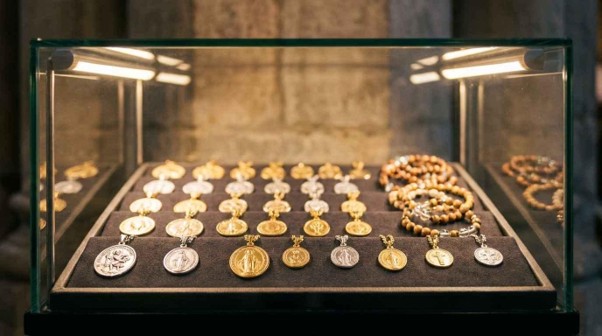
The problem for visitors is that the same streets that hold serious, decades-old religious jewelers also hold souvenir racks stacked with plated trinkets aimed squarely at tourists in a hurry. Knowing which is which saves both money and disappointment.
Georges Thuillier, La Procure and Au Service de la Liturgie: The Saint-Sulpice Quarter
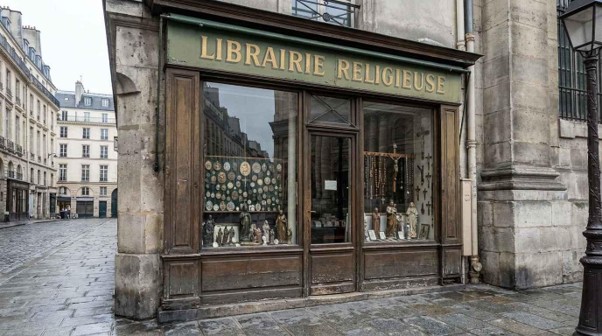
The area around Place Saint-Sulpice in the 6th arrondissement has been Paris’s religious goods district for over a century, and it’s the first place regulars point newcomers toward. Georges Thuillier, at 10 Place Saint-Sulpice, has traded in religious jewelry, medals and santons since 1948 and still runs as a family business, with books, icons and pendants side by side in a shop barely bigger than a living room. A few steps away, La Procure at 3 rue de Mézières has operated since 1919 as Europe’s largest religious bookshop, and alongside its 80,000 titles it keeps a dedicated counter of medals, icons and cards for baptisms and communions. Au Service de la Liturgie, at 8 rue Madame, leans more toward vestments and church supplies but sells medals, chaplets and crosses to individual visitors too, with nationwide shipping if you run out of suitcase space. If a cross rather than a medal is the goal, it’s worth knowing why that particular symbol became the default Christian one in the first place, which this overview of the cross in Christianity lays out well.
None of these three feel built for tourists, which is exactly the point: staff know their stock, and prices reflect materials rather than foot traffic.
Cathedral and Basilica Boutiques: Notre-Dame and Sacré-Coeur
Buying a medal from the site it depicts has an appeal no external shop can match, and both of Paris’s most visited churches now run their own boutiques for it.
The Notre-Dame de Paris shop reopened inside the cathedral on 8 December 2024, alongside the building itself after its five-year restoration, and sells gold, silver, gold-plated and bronze medals, pendants and bracelets, including a gold Miraculous Medal ring.
The Sacré-Coeur de Montmartre boutique carries a similar range, from a €75 gold-and-black Miraculous Medal necklace to simpler gold-plated souvenir medals, and every purchase funds the basilica directly. Both shops list their catalog in English online, which makes browsing ahead of a visit easier than working out a French checkout on the spot.
Mainstream Jewelers and Other French Online Options
Away from the church-owned shops, Paris also has historic houses that aren’t exclusively religious but carry a serious catalog of it. Arthus Bertrand, founded in 1803, is one of them, listing medals for the Virgin, saints and Christ alongside secular symbols like the tree of life or the dove. Ordinary French jewelry chains keep a religious section too: Histoire d’Or, with stores across the country, lists rings, pendants and crosses under its own religious jewelry category, generally at chain-store prices rather than fine-jewelry ones. Specialist online catalogs such as Cathoretro also exist, splitting their range between costume pieces and precious metal, including women’s rings, a category the church boutiques and dedicated medal houses barely touch.
Sanctis: The Online Alternative When You Don’t Have Boutique Time
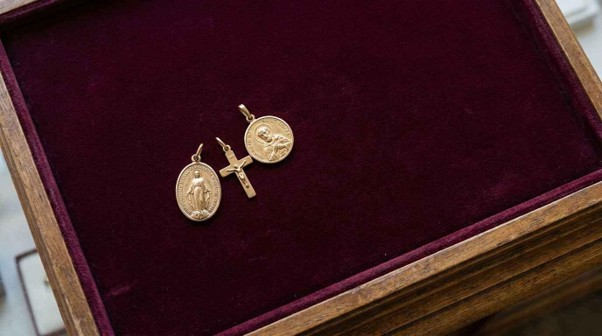
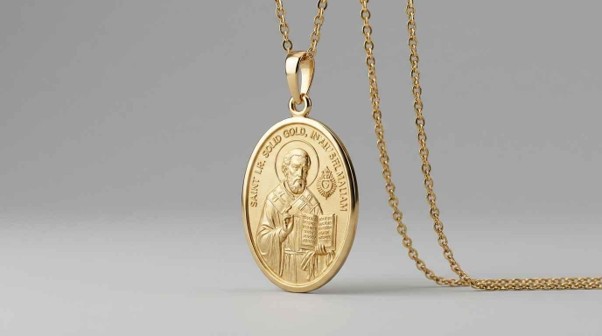
For visitors who’d rather order before the trip, or who simply run out of Saint-Sulpice afternoons, Sanctis is the most straightforward French option. The house has specialized in religious and baptismal medals since 1959, still making everything in its own workshop in Saumur, and its religious jewelry collection runs from the Miraculous Medal to crosses, angels and saints, mostly in 18-carat gold with a few silver pieces. Engraving on the back is included at no extra cost, and pricing across the catalog typically falls between roughly €95 for a small silver piece and €580 or more for larger 18-carat gold designs. Sanctis ships internationally, so a medal ordered from a hotel room in Paris can still arrive at a home address abroad.
The one real limitation is language: the site itself is in French only, so non-French speakers will be relying on a browser translator at checkout. It’s also, like the Saint-Sulpice houses, built around medals, crosses and bracelets rather than rings, so anyone set on a religious ring specifically will still need one of the other options above.
How to Avoid Low-Quality Tourist Junk
The giveaway is almost always the metal claim. A piece marked « or 18 carats » or « argent 925 » in France carries a legal hallmark, a small stamped mark on the jewelry itself, and any shop selling genuine precious metal should be able to point it out without hesitation. Gold-plated and costume pieces aren’t dishonest by themselves, plenty of visitors want an affordable keepsake rather than an heirloom, but a shop that can’t answer a direct question about the metal, or that only sells from a folding table rather than a fixed address, is a reasonable one to walk past. Weight is a simpler tell too: solid gold and silver medals have a noticeable heft that plated brass doesn’t.
Our Take
If a slow afternoon in the 6th arrondissement fits the itinerary, the Saint-Sulpice quarter is hard to beat for browsing several serious, independently run shops within a five-minute walk of each other, with Georges Thuillier the most jewelry-focused of the three. Anyone who wants a medal tied specifically to Notre-Dame or Sacré-Coeur should buy from the on-site boutique rather than a nearby souvenir stand, since that’s the only way to be sure the purchase supports the building it depicts.
For everyone else, especially travellers who’d rather have a piece waiting at home than carry it through security, Sanctis covers the same French, solid-metal, workshop-made territory as the Saint-Sulpice shops without needing a single afternoon of the trip.
Frequently Asked Questions
Is it safe to buy religious jewelry from souvenir stands near Notre-Dame or Sacré-Coeur?
Official boutiques inside the cathedral and basilica are the safer bet. They sell hallmarked gold, silver or gold-plated pieces and the proceeds go toward the site itself, while unaffiliated stalls on the surrounding streets typically sell unmarked costume jewelry with no such guarantee. If a medal is meant to commemorate the specific church, buying it from that church’s own shop is the only way to be certain of what it’s made of.
What is the difference between solid gold and gold-plated Catholic medals?
Solid gold, usually 18 carats in France, is gold all the way through, carries a legal hallmark, and keeps its color and value for decades. Gold-plated pieces are a base metal, often brass, with a thin layer of gold applied on top, so they cost far less but the plating can wear thin with daily contact against skin or clothing. Both are legitimate purchases, the choice comes down to whether the medal is meant to last a lifetime or serve as an affordable souvenir.
Can I get a medal engraved while I’m in Paris?
Yes. The Saint-Sulpice quarter shops, including Georges Thuillier, offer engraving on medals bought in store, usually with a short wait rather than same-day service. Sanctis includes engraving at no extra charge on its medals, though since the order ships from the Saumur workshop it needs to be placed before leaving France rather than picked up in person.
Does Sanctis ship Catholic jewelry outside France?
Yes, Sanctis ships both within France and internationally, so a medal ordered during a trip to Paris can be delivered to an address in another country afterward. The checkout itself is in French only, which is worth knowing before ordering.
Why is the Miraculous Medal so common in Paris shops specifically?
The medal’s origin is Parisian. It was first struck after Marian apparitions reported by Sister Catherine Labouré in 1830 at the convent chapel on rue du Bac, and it became especially popular after being credited with protecting people during the 1832 cholera epidemic. The original chapel is still active in Paris today, which is part of why nearly every religious jeweler in the city, from Saint-Sulpice to Sanctis, carries a version of it.
Is the Notre-Dame gift shop open again after the fire?
Yes. Notre-Dame de Paris reopened on 7 December 2024 following the five-year restoration after the 2019 fire, and its on-site boutique reopened inside the cathedral the following day, 8 December 2024, selling the same jewelry and souvenirs available on its online store.